There is a particular quality in the air as February has been calmly and quietly sliding into March about to move from late winter to spring. The birds are taking up their songs, days are lengthening and we are eagerly waiting and watching for grass starting to grow. In Traditional Chinese Veterinary Medicine (TCVM), this sensation has a name and a reason. It is the movement of Qi beginning to shift, and for those of us who work with horses through the lens of TCVM and acupressure, this seasonal transition is one of the most important – and most nuanced – times of the year.
The Season Through a TCVM Lens
TCVM divides the year not just into four seasons but into five phases, and late winter rests at the crossroads between the Water phase and the emerging Wood phase. Water is the element of winter. It is characterised by depth, stillness, inward direction, restoration. It is the most Yin phase of the year. The Kidney and Bladder are its governing organ systems. Horses who have wintered well have been storing Jing (essence) and building reserves. A long, cold season can deplete these resources significantly, especially in older horses, those with heavy workloads carried into winter, or horses living in harsh climates.
As the days begin to lengthen and temperatures increase, we orient ourselves to the east and feel Yang energy emerging similar to the rising sun at daybreak. Wood, as the primary energy of spring, starts to awaken. Wood is governed by the Liver and Gallbladder. Its nature is expansive, upward-moving, and driven – similar to the first green shoots pressing through cold or frozen ground. For our horses, this means the body is being asked to shift gears from contraction to expansion, from storage to movement, from stillness to growth.
Acupressure Points to Support the Transition from Winter to Spring
Equine acupressure works by applying gentle, sustained pressure to specific points along the body’s meridian pathways, encouraging the smooth flow of Qi and Blood. During the late winter to spring transition, a well-chosen equine acupressure session can support Kidney Qi that may be depleted from the winter months, encourage the smooth flow of Liver Qi, and gently prepare the horse’s musculoskeletal and digestive systems for increased activity.
The following acupoints can support this transitional period. Always approach equine acupressure sessions with a calm, grounded energy, allow the horse to guide you with their responses, and work in an environment where you are undisturbed and the horse can relax.
Liver & Gallbladder Acupoints
These acupoints move stagnant Qi that may accumulate over winter and support the liver’s role in detoxification and smooth energy flow.
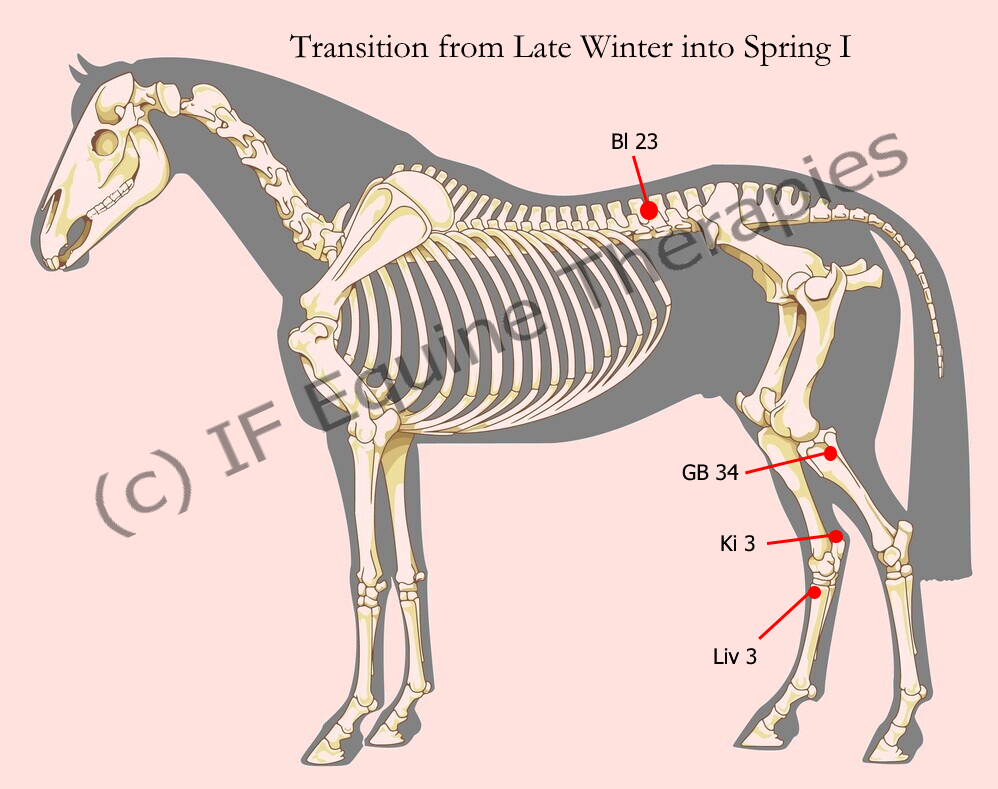
Liver 3 (Liv 3)
Taichong | Supreme Surge | Earth point | Source point.
Location: On the craniomedial aspect of the cannon bone. At the level of the head of the medial splint bone.
Liver 3 promotes the smooth flow of Liver Qi and the calming of the mind.
Gallbladder 34 (GB 34)
Yang-Ling-Quan | Yang Tomb Spring | Earth point.
Location: In the depression craniodistal to the head of fibula, in the interosseus space between the tibia and fibula between the long and lateral digital extensors.
Influential point for tendon and ligaments. A major point of the body that can be used to regulate the smooth flow of liver Qi in the entire body. Supports the flow of blood and Qi in the legs and the relaxation of tendons.
Kidney & Bladder Acupoints
Bladder 23 (Bl 23)
Shen-shu | Kidney Shu Point| Association point.
Location: 3 cun lateral to the ventral midline between the second and third lumbar vertebrae, in the muscular groove between the longissimus lumborum and iliocostalis lumborum mm. This point is often found directly dorsal to the caudal aspect of the last rib.
Bl 23 is the Association point (Shu point) for the Kidney, i.e. it essentially is a direct access point to the Kidney organ system. It tonifies Kidney Yin, strengthens the brain, bone and marrow, benefits the mind, and strengthens the caudal back and stifle.
Kidney 3 (Ki 3)
Taixi | Greater Stream | Earth point | Source point.
Location: In a depression between the medial malleolus and the tendocalcaneus at the level of the tip of the medial malleolus (opposite to Bladder 60).
This acupoint tonifies Kindney Yin and benefits essence (Jing). Supports the caudal back.
In Part 2 of this post, I will share further acupoints with you that support overall balance as well as the digestive system as many of our horses will be moving to fresh grass in the coming weeks and months.
You can incorporate these sessions into your grooming or any other routine. Start by holding each acupoint with gentle, steady finger pressure for 30–60 seconds, releasing when you feel the horse soften. Apply the session on both sides of the horse. Work in a calm environment where you and your horse are undisturbed. Always observe your horse’s responses and stop if they show any sign of discomfort or pain and seek clarification for the source of such adverse reaction. These sessions complement, but don’t replace veterinary care.
Leave at least 2 hours after feeding any hard feed. Do not apply acupressure on in-foal mares as this can induce labour. Seek veterinary advice first on any issues that you may encounter.
Note: Equine acupressure is a complementary modality and is not a substitute for veterinary care. Always consult with a veterinarian or a certified TCVM practitioner before beginning an acupressure program, especially for horses with existing health conditions.