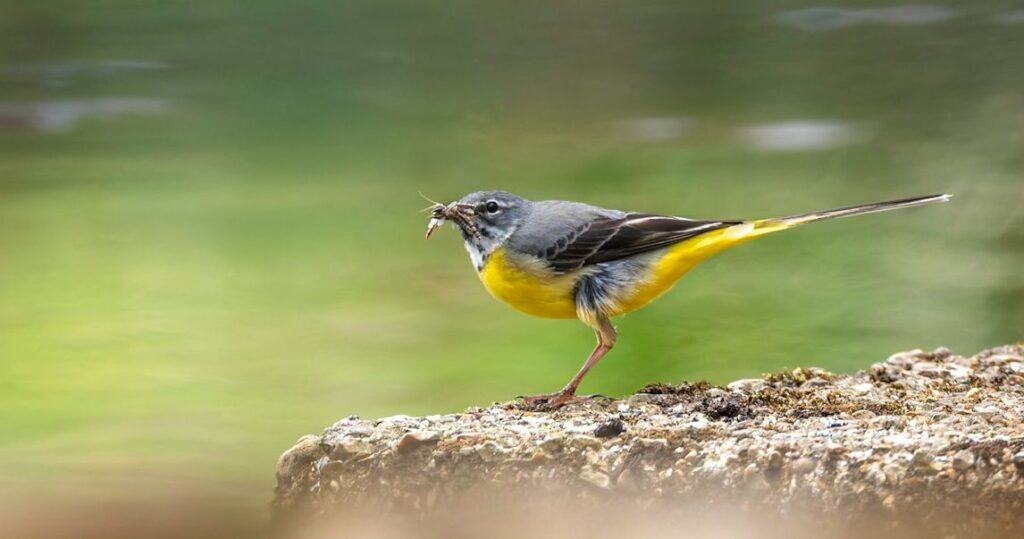
In the one week since I published the first part of this article, spring has noticeably picked up speed. The evening stretches are getting longer and even the cooler temperatures do not feel as harsh anymore. Birds are ever more active and just the other day, I happened to meet a grey wagtail in the yard. They have been nesting here since I first moved in about 3 years ago and have been returning ever since. This fills me with particular delight, as they are red listed in Ireland. We as horse people, using land and outdoor spaces, have an opportunity to ‘manage’ and ‘design’ these spaces in a wildlife-friendly way. Often this can be done in ways that also improve and enrich the spaces our horses inhabit. So let us all become stewards of our land and outdoor spaces, rather than viewing them as mere commodities to be used for our sole benefit.
But now, back to helping our horses through a smooth transition into spring.
Acupressure Points to Support the Transition from Winter to Spring
In Part 1, we looked at supporting both the Water and the Wood element by addressing their associated Kidney and Liver organ systems. At this time of the year, I would also like to add a few acupoints to support the digestive system and encourage general balance. With equine acupressure, we can support our horses’ digestive system during such changes.
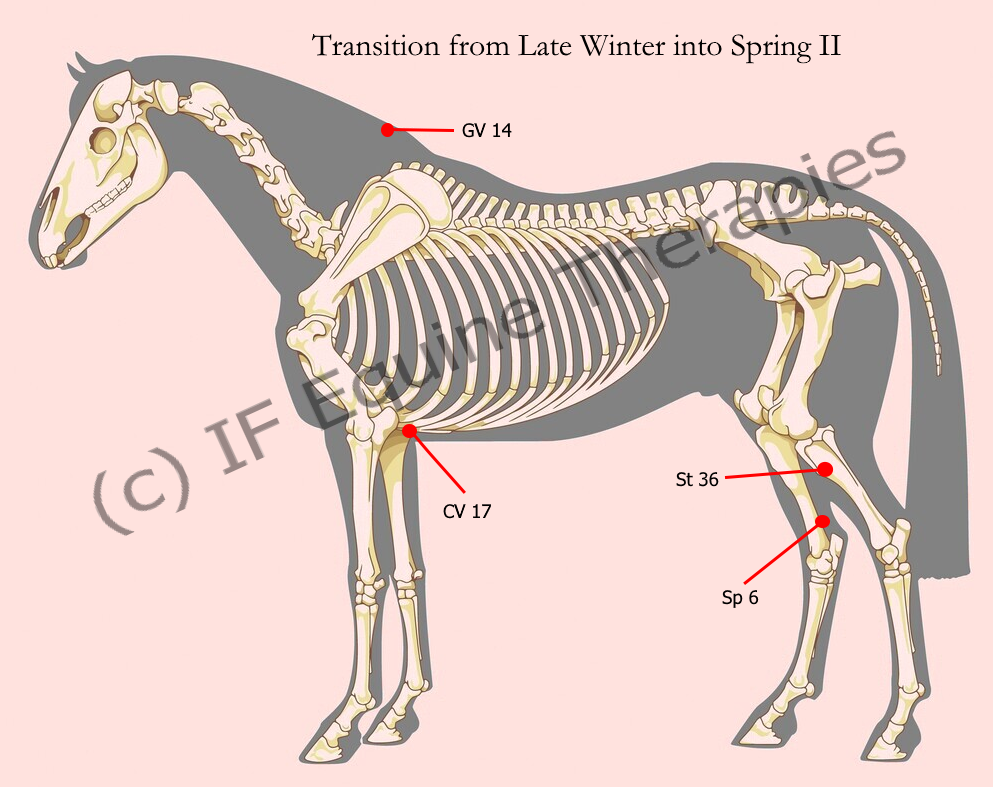
Stomach & Spleen Acupoints
For many horses, the transition into spring brings significant changes to their diet. Many will be turned out onto fresh grass for the first time in months, while some may be returning to work after a winter out on pasture.
Stomach 36 (St 36)
Hou-Sanli | Hind Three Miles | Earth Point
Location: In the depression just lateral to the tibial crest, in the muscular groove between the tibialis cranialis and the long digital extensor muscles, 2 cun distal to the proximal edge of the tibial crest.
Stomach 36 is the Master point for the abdomen and the digestive system. It supports digestive function and tonifies Qi and Blood — a great acupoint for boosting immunity, digestion and overall vitality.
Spleen 6 (Sp 6)
San-Yin-Jiao | Three Yin Meeting
Location: 3 cun proximal to the tip of the medial malleolus, just caudal to the caudal border of the tibia, 0.5 cun posterior to the saphenous vein.
Spleen 6 is the Master point for the caudal abdomen and the urogenital tract, sitting at the crossing of the Spleen, Liver and Kidney meridians. It benefits gastrointestinal function, tonifies Qi, Blood and Yin, and harmonises Liver, Spleen and Kidney simultaneously.
General Balancing Points
Governing Vessel 14 (GV 14)
Da-Zhui | Big Vertebra | Sea of Qi Point
Location: In a depression on the dorsal midline between the spinous processes of the seventh cervical and first thoracic vertebrae, at the base of the neck and withers.
GV 14 boosts Yang energy and supports the immune system.
Conception Vessel 17 (CV 17)
Shan-Zong | Middle of Chest | Sea of Qi Point
Location: On the ventral midline at the level of the caudal border of the elbow.
Alarm point of the Pericardium. An influential point for the respiratory system and Qi, it supports the diaphragm and opens the chest.
Supporting the Transition Beyond the Session
Acupressure is most effective when it sits within a broader approach to care during this time of year. From a TCVM perspective, diet, movement and environment can all play a meaningful role in supporting the seasonal shift.
Horses moving from winter forage toward spring grass should be transitioned gradually — not only to avoid digestive upset, but because the rich, damp nature of early spring grass can challenge the Spleen and Stomach if introduced too quickly. Keeping good quality hay available as a base goes a long way toward supporting smooth digestive function through this change.
Movement, too, is one of the best medicines for Liver Qi stagnation. Long, forward walking — ideally outdoors where the horse is exposed to the expanding world around them — encourages the free flow of Qi and helps the body shed the contraction of winter. If your horse has had time off, resist asking for tight or collected work before the musculoskeletal system has had a chance to re-engage and find its rhythm again. The Wood element favours energy that moves upward and outward, not compression.
Finally, pay attention to the small things in your horse’s surroundings. Consistent routines, calm handling and time simply to move and stretch without agenda do not take much effort but add a lot in terms of harmony and balance.
A Practice of Presence
What TCVM and acupressure offer, perhaps more than any single technique, is a framework for truly seeing and observing our horses — for noticing the subtle shifts in coat quality, eye brightness, temperament, and movement that signal how they are navigating the change of the seasons. Late winter into spring is a particularly rich time for this kind of attention, when the whole natural world is about to shift from a state of rest and renewal into one of activity and growth.
Your horse is part of that turning. When you place your hands quietly on an acupoint and feel the softening in their body, you are participating in something both ancient and deeply practical — a conversation between species, held in the language of the body, opening the possibility for change.
When applying equine acupressure, leave at least 2 hours after feeding any hard feed. Do NOT apply acupressure on in-foal mares as this can induce labour. Seek veterinary advice first on any issues that you may encounter.
Note: Equine acupressure is a complementary modality and is not a substitute for veterinary care. Always consult with a veterinarian or a certified TCVM practitioner before beginning an acupressure program, especially for horses with existing health conditions.