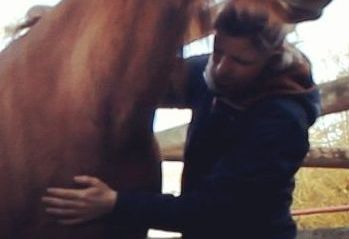
Reflections on Equine Bodywork in the Age of AI
Farmer, author and environmentalist Wendell Berry once wrote that “the next great division of the world will be between people who wish to live as creatures and people who wish to live as machines”.
We live in a moment of extraordinary technological acceleration. AI-powered diagnostic tools, sensor-based movement analysis, data-driven treatment protocols and training platforms, algorithm-assisted breeding decisions are entering the horse world. The equine industry is embracing them quickly. Some of these tools are valuable. But for those of us working within traditions that are hundreds or, in some cases, thousands of years old, they also raise an important question: what kind of knowing are we being asked to replace?
Different Ways of Knowing
Equine bodywork and Traditional Chinese (Veterinary) Medicine are not low-tech alternatives to modern medicine. They are different ways of knowing and approaching and connecting with horses and that distinction matters.
When a bodyworker follows a fascial line through a horse’s body and feels its quality under his hand, they are not simply gathering data. They are in conversation with another body putting the information in their hands into a wider context. When a TC(V)M practitioner reads a pulse, assesses an acupoint, considers the five elements and the horse’s history when establishing the root of an imbalance, they are practising a form of pattern recognition that is so nuanced and embodied that no algorithm can replicate it.
There is a reason that the most gifted equine bodyworkers and TCVM practitioners are so often people who have spent decades with horses in a broader sense, not only in clinical practice, but in the field, the arena and the stable. Years in and out of the saddle leave their mark on a person in ways that are difficult to articulate but impossible to fake. The experienced and sensitive horseman or horsewoman has developed a sensory vocabulary – a feel as you may say – that is entirely their own, an ability to recognise tension before it becomes resistance, to notice the slight irregularity of a gait before it becomes lameness, to know the quality of a stride beneath them, to sense that something is not quite right even though there may be no obvious sign to the untrained eye and to track down that sensation to its core. They read posture, movement, breathing, eye quality, muscle tone, tail carriage and skin sensitivity as naturally as others read text. These are skills that cannot be downloaded or accelerated. They are the slow accumulation of presence and of having shown up day after day and paid attention over years and decades.
The Intelligence of our Hands and our Senses: Palpation and Sensory Perception as Primary Language
At the heart of both equine bodywork and TC(V)M lies the educated, listening hand.
Palpation is far more than physical examination. It is a language, a language that is learned slowly, over years, through numerous encounters with horses in varying states of health, tension, ease and distress. The practitioner’s hands learn to distinguish subtleties, to read the body and its responses through their hands, and then to apply their hands in accordance with what is needed and asked of them. It is a dialogue between species mediated by our hands and expressed through the body.
In TC(V)M, palpation of the pulse is one of the most sophisticated diagnostic arts in any healing tradition. The quality, depth, rate, rhythm, and character of the pulse at different positions communicates the state of the organ systems, the nature of a pathogenic influence, the strength of Qi and Blood. A slippery pulse tells a different story to a wiry one. This is information that lives in the fingertips of the practitioner.
Palpation along the Bladder meridian, the channel that runs along either side of the spine and is connected to all other organ systems of the body, reveals patterns of heat, cold, excess and deficiency that map directly to any organ system imbalance. A reactive point at Bl 13 speaks to the Lung. Tension clustering around Bl 23 points toward the Kidney. The horse’s body is not merely a physical structure but an energetic landscape, and palpation is how we learn to read it.
For the equine bodyworker, the hands learn the difference between a trigger point and a taut band, between a rib that is restricted in its movement and one that moves freely with the breath, between a horse who is bracing against anticipated discomfort and one who is beginning to let go. That moment of release is felt before it is seen.
The most sophisticated instrument available to the equine practitioner has always been a human being who has learned to truly pay attention.
A Medicine of All the Senses
From a modern Western perspective, TC(V)M asks something radical of its practitioners: that they bring every sense fully to each patient encounter. This is not metaphor. It is at the heart of this ancient healing tradition.
And it is encompassed in the four assessment methods: 1. Inspection, 2. Listening and Smelling, 3. Inquiry, 4. Palpation.
The practitioner looks at the horse’s coat quality, his posture and movement, the brightness or dullness of the eye, his overall impression and attitude, his muscle tone, etc. These visual observations, refined through experience, carry enormous weight in identifying underlying patterns. They tell about cold and deficiency, heat and excess, Yin and Yang, and the affected organ systems. None of this requires a machine. It requires years of observing and the ability to translate these observations into the identification of patterns and then to most efficiently address and resolve them.
The practitioner listens not only to what the horse handler or owner reports, but to the horse herself. The quality of her breath. The way her exhalation deepens and slows when hands touch her body or a needle finds its mark.
The practitioner smells. This is perhaps the most neglected sense in Western clinical education, but in TC(V)M it carries real information. The smell of the horse can point toward patterns of excess or deficiency, toward heat conditions or damp accumulations. A horse with Kidney Yang Deficiency may have a particular quality to his coat and breath. These are subtle signals, but to a trained nose they mean something.
The practitioner feels, not only through formal palpation, but through the quality of contact the horse initiates or avoids, through the temperature differences between different regions of the body, through texture under the practitioner’s hands, through the responses when the hand touches particular spots, through the ease or resistance of a joint through its range of motion.
And the practitioner gathers information from the handler or owner, but also of the horse himself. Where is the holding? Where does it get lighter? What does this animal move toward, and what does he consistently avoid? A horse that persistently presents his left side, or that is reactive to girthing in a particular way, or that has developed a pattern of resistance in exactly one movement. These are not just symptoms to be addressed or problems to be corrected. They are communications to be understood and put into context in a living breathing system.
What AI Can and Cannot Do
This is not an argument against technology. There are things AI-powered tools do remarkably well. Gait analysis software can detect subtle asymmetries invisible to the human eye. Thermal imaging can reveal areas of inflammation before they become clinically obvious. Data aggregated across thousands of horses can surface patterns no single practitioner could accumulate in a career. It is an argument for discernment and for not giving up and losing what cannot be replaced and replicated.
What AI cannot do is be present. It cannot feel the quality of tissue under its hands or notice the way a horse’s breathing changes when you approach a particular spot. It cannot hold a pulse between three fingers and understand from its quality and depth, that this horse is constitutionally depleted and needs warming and nourishing rather than dispersing and moving. It cannot register the slight but unmistakable softening in a horse’s eye that tells you the needle has met the right spot and its associations.
The pressure to validate, quantify and technologise is ever more real for practitioners in our fields. To prove that what you do is legitimate, there can be a temptation to reach for the language of the machine and to reduce the work to data points and measurable outcomes. Resist it. Not because evidence does not matter, but because the moment you stop trusting the information in your hands, your eyes, your nose, your ears and and your felt sense of the animal in front of you, you have lost the most important tool you have.
What This Means for Clients
For those who seek out these therapies for their horses, choosing them is itself an act of orientation. You are choosing to believe that your horse is not a functioning unit to be optimised, but a complex being to be understood. That chronic tension, recurring resistance or unexplained dullness might not have a purely mechanical answer and a practitioner who sits quietly with your horse, observes, palpates and listens with every sense, may find what the scans missed.
The horse that releases a long-held tension under a skilled pair of hands, the acupuncture point that unlocks a pattern of resistance that no lameness workup could locate. Theses are not separated or fragmented symptoms in a living body open to a simple fix or optimisation. These are patterns in a complex system that can only be met by a skilled, attentive practitioner.
Embodied Presence & Attention as Radical Acts
The great division that Wendell Berry was speaking about is not between the modern and the old-fashioned. It is between attentive, embodied presence and the slow erosion of everything that cannot be quantified, technologically tracked or optimised. Equine bodywork and TC(V)M exist and persist and are growing, because horses are creatures, not machines. They are whole, complex, emotional, energetic, living and breathing beings. And because some practitioners have always understood that the most important thing you can bring to the stable is your full, calm and receptive presence.
That means your hands. But it also means your eyes, your ears, your nose, your felt sense, your patience, your body and your willingness to let the horse tell you what she needs rather than arriving with a predetermined protocol and agenda. And it means to step away and create some distance from a lifestyle that, not only today but over decades, has removed us from using and accessing the full capacity of our senses.
That is not a small thing. In the world we are moving into, it may be a radical one. And it may ask from us to stand tall and resist the pressure by the mainstream dominant culture that values speed and purported efficiency over the integrity of a practice built on presence, touch, relationship and slowly developed skills and wisdom.