In der Traditionellen Chinesischen Veterinärmedizin (TCVM) versteht man Meridiane(Jing Luo)als energetische Leitbahnen des Körpers, durch die Qi (Lebensenergie) und Blut im Körper zirkulieren. Bei Pferden verbinden diese Leitbahnen die inneren Organe und weitere physiologische Strukturen wie Muskeln, Faszien, Sehnen, die Haut, Sinnesorgane usw. Sie verbinden den Körper als ein integriertes, kohärentes, wechselseitig voneinander abhängiges Ganzes.
Meridiane gelten als funktionelles Netzwerk, das Qi und Blut im gesamten Körper verteilt, das Gleichgewicht zwischen den Organsystemen und anderen körperlichen Strukturen aufrechterhält, die Körperoberfläche mit den inneren Organen verbindet und Bewegung, Schmerzen, Immunität, Verdauung, Atmung, Emotionen und Verhalten beeinflusst. Wenn der Qi-Fluss stagniert oder aus dem Gleichgewicht gerät, können Krankheiten oder Schmerzen auftreten.
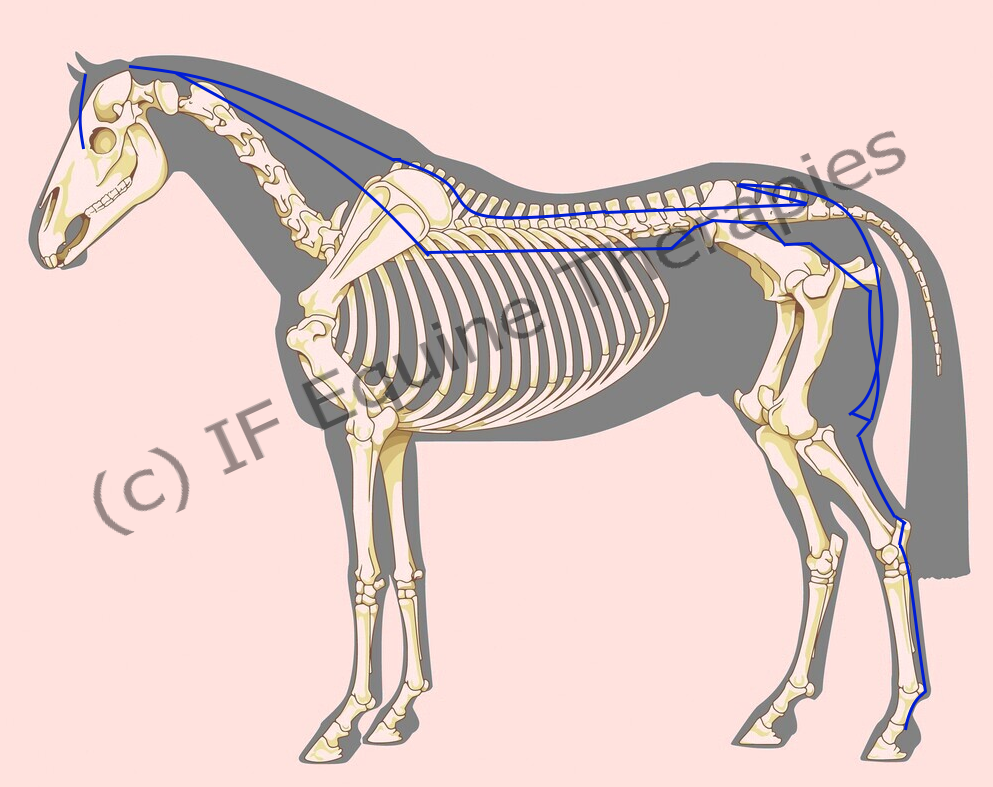
Abbildung: Verlauf des Blasenmeridians beim Pferd
Die 12 Hauptmeridiane des Pferdes
Es gibt 12 Hauptmeridiane, die beidseitig am Körper des Pferdes verlaufen. Jeder Hauptmeridian ist mit einem bestimmten Organsystem verbunden und steht in einer Yin-Yang-Beziehung zu einem anderen Organ, d. h. jedes Zang-Organ (Yin) ist mit einem Fu-Organ (Yang) gepaart.
| Yin (Zang) | Yang (Fu) |
| Lunge (Lu) | Dickdarm (Di) |
| Milz (Mi) | Magen (Ma) |
| Herz (He) | Dünndarm (Dü) |
| Niere (Ni) | Blase (Bl) |
| Perikard (Pe) | Dreifacherwärmer (3e) |
| Leber (Le) | Gallenblase (Gb) |
Yin-Meridiane verlaufen im Allgemeinen entlang der medialen und ventralen Körperoberfläche der Gliedmaße und des Rumpfes, während Yang-Merdiane entlang der lateralen und dorsalen Körperoberfläche verlaufen.
Zwei Außerordentliche Gefäße
Neben den Hauptmeridianen gibt es acht außerordentliche Gefäße, von denen zwei besondere klinische Relevanz haben:
- Lenkergefäß (LG / Du Mai / Meer des Yang): verläuft dorsal entlang der Mittellinie, steuert alle Yang-Meridiane.
- Konzeptionsgefäß (KG / Ren Mai / Meer des Yin): verläuft ventral entlang der Mittellinie, reguliert alle Yin-Meridiane.
Während das Konzeptionsgefäß und das Lenkergefäß an der Körperoberfläche verlaufen und über eigene Akupunkturpunkte verfügen, verlaufen die anderen sechs außerordentlichen Gefäße tiefer im Körperinneren und sind über Akupunkturpunkte auf den anderen Meridianen erreichbar. Sie haben insbesondere Bedeutung bei der Behandlung komplexer oder chronischer Erkrankungen sowie tiefsitzender Ungleichgewichte.
Akupunkturpunkte
Auf diesen Hauptmeridianen und außerordentlichen Gefäßen befinden sich bestimmte Punkte, sogenannte Akupunkturpunkte, die auf den Leitbahnen liegen. Diese Akupunkturpunkte werden genutzt, um den stagnierenden oder unausgeglichenen Qi-Fluss anzuregen und zu regulieren, damit der Körper des Pferdes wieder ins Gleichgewicht findet. Praktizierende nutzen dazu ihre Hände oder Finger oder Hilfsmittel wie Nadeln, Laser oder Moxibustion / Moxa. Neben den 361 Akupunkturpunkten, die auf den Meridianen liegen, gibt es weitere klassische Akupunkturpunkte, die sich nicht auf einem Meridian befinden, aber wichtige Körperfunktionen unterstützen.
Diagnose und Therapie
Praktiziernde der Traditionellen Chinesischen Veterinärmedizin nutzen diese Meridiane und Akupunkturpunkte sowohl zur Diagnose als auch zur Therapie. Sie beurteilen die Meridiane, indem sie entlang der Meridianbahnen auf Empfindlichkeit abtasten, Temperaturveränderungen feststellen, Muskelverspannungen beobachten, auf Verhaltensreaktionen beim Berühren achten und weitere Empfindungen wahrnehmen und einordnen, die ihnen auffallen. Neben der Beurteilung des Meridians als Ganzes werden auch bestimmte Akupunkturpunkte zur Diagnose herangezogen.
Blasenmeridian
Einer der Hauptmeridiane, der im Zusammenhang mit Diagnosestellung und therapeutischer Intervention von besonderer Bedeutung ist, ist der Blasenmeridian. Mit 67 Akupunkturpunkten und einem Verlauf vom Kopf über den Hals, den Rücken und die Hinterhand bis hinunter zum Hinterhuf ist er der längste Hauptmeridian. Dort, wo er beidseitig entlang der Wirbelsäule des Pferdes verläuft, verfügt er über eine Reihe von Akupunkturpunkten, die mit allen 12 Organsystemen, deren Meridianen sowie den damit verbundenen Strukturen und Funktionen des Pferdekörpers in Verbindung stehen. Diese sogenannten Rücken-Shu-Punkte ermöglichen es uns, Ungleichgewichte und Funktionsstörungen in den zugehörigen Meridianen und Organsystemen sowohl festzustellen als auch zu behandeln.
Aus westlicher Sicht
Die wissenschaftliche Veterinärmedizin kennt keine Meridiane oder vergleichbare anatomische Strukturen. Einige Forscher vermuten jedoch Zusammenhänge mit etablierten physiologischen Systemen wie Bindegewebsebenen, myofaszialen kinetischen Linien, neuromuskulären Verbindungen oder dem Nervensystem. Auch wenn noch viel zu erforschen bleibt, hat sich unser Verständnis aus westlicher Sicht, warum die Methoden der Traditionellen Chinesischen Veterinärmedizin so wirken, wie sie es tun, kontinuierlich verbessert und erweitert.